Product Discovery Framework: A Simple System to Find and Validate Product Ideas

Most people waste months (or years) stuck in “thinking mode”—overcomplicating what should be a simple product discovery
No clear product. No direction. Just ideas going in circles.
You second-guess your direction, spend time on the wrong things, and end up with little to show for it.
That’s where the Product Discovery Framework comes in.
It’s a simple, structured approach to help you move from vague ideas to a clearly defined product—one step at a time.

Table of Contents
Product Discovery Framework
The Product Discovery Framework is a lightweight system designed to help you find and validate product opportunities through small, iterative steps.
This is the second step in the Product Loop
Instead of trying to build the “perfect” product upfront, this framework helps you gradually shape your idea into something clear, focused, and valuable.
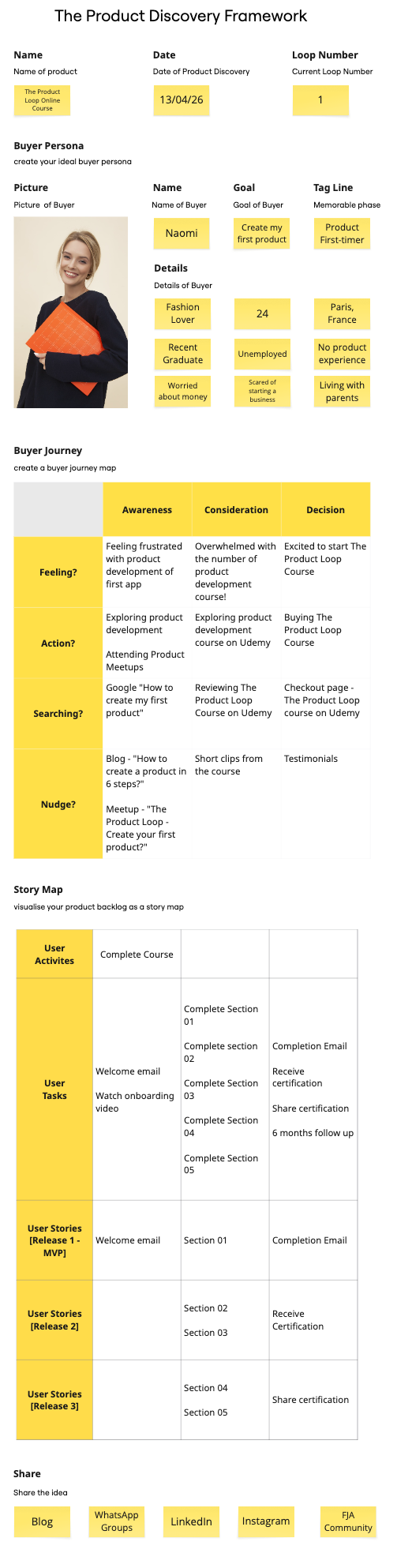
At its core, the framework consists of seven simple components:
Name – What is your product called?
Date – When did your discovery process start?
Loop Number – Which iteration are you on?
Buyer Persona – Who is your ideal customer?
Buyer Journey – How does your customer move toward purchase?
Story Map – How is your product structured and delivered?
Share – How do you communicate your discovery?
Case Study – Product Discovery Framework in Action
Naomi is an aspiring high-end fashion designer and entrepreneur. She has built a strong audience—over 200k followers on Instagram and 10 million views on YouTube.
Despite this traction, she struggled to define a clear product idea.
She was spending time and money without meaningful progress. On top of that, her content creation slowed down, increasing her stress.
By adopting the Product Discovery Framework, Naomi was able to:
Clarify her product idea
Understand her customer
Map her buyer’s journey
Structure her product through a story map
Together, we applied the framework to discover a product: an online course for early-stage entrepreneurs with little to no product discovery experience.
Step 1 – Name Your Product
Start by naming your product.
This may seem simple, but naming forces clarity. It gives your idea identity.
After brainstorming 17+ ideas, we selected:
✅ Product Name: Product Loop Online Course
Step 2 – Set Your Start Date
Next, define when your product discovery begins.
This creates a clear starting point and builds accountability.
✅ Start Date: 13/04/26
Step 3 – Define Your Loop Number
Product discovery is iterative.
Each loop represents a cycle of learning, testing, and refining.
For this case:
✅ Loop Number: 1
Step 4 – Create Your Buyer Persona
Now, define your ideal customer.
To build this persona, we:
Visualised the buyer
Gave them a name
Defined their goal
Created a memorable tagline
Added relevant personal and behavioural details
This step ensures you are building for someone specific, not everyone.
We created a persona called: Naomi
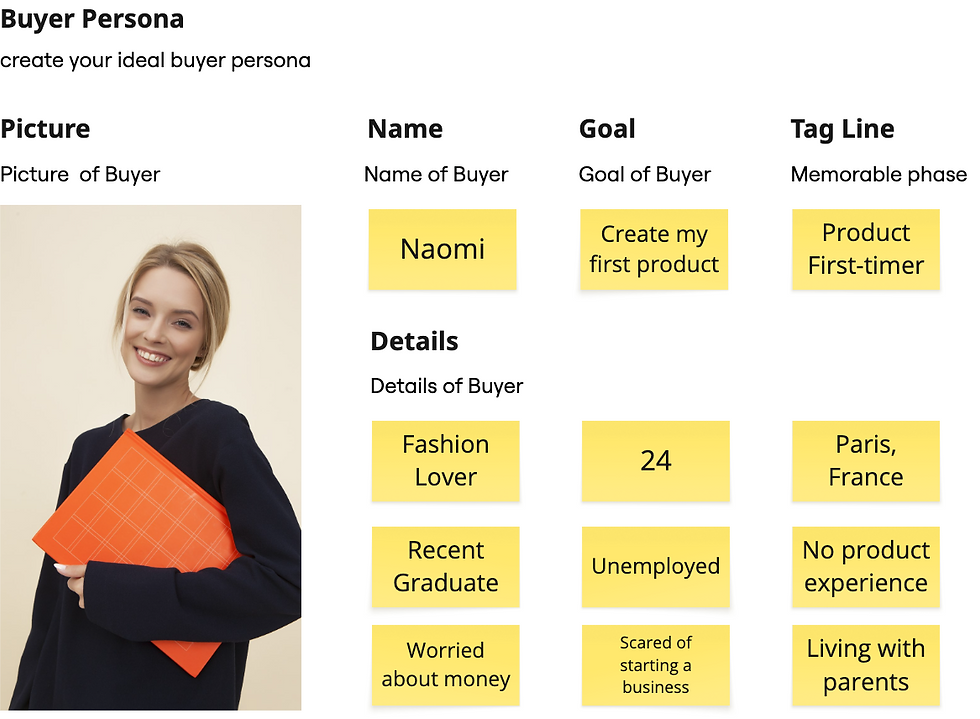
✅ Naomi – Product First-Timer
Step 5 – Map the Buyer Journey
Next, map how your buyer moves toward a purchase.
We defined three key stages:
1. Awareness - The buyer realises they have a problem
2. Consideration - The buyer explores solutions
3. Decision - The buyer chooses a provider
For each stage, we analysed:
Feeling – What are they thinking or feeling?
Action – What are they doing?
Search – Where are they looking for answers?
Nudge – How do we move them forward?

✅ Buyer Journey: Naomi’s path to purchase
Step 6 – Build a Story Map
The story map helps you visualise your product and organise your backlog.
It includes:
User Activities – High-level goals
User Tasks – Steps to complete each activity
User Stories – Features from the user’s perspective
Releases – Deliverable versions of the product
This step turns your idea into something structured and actionable.
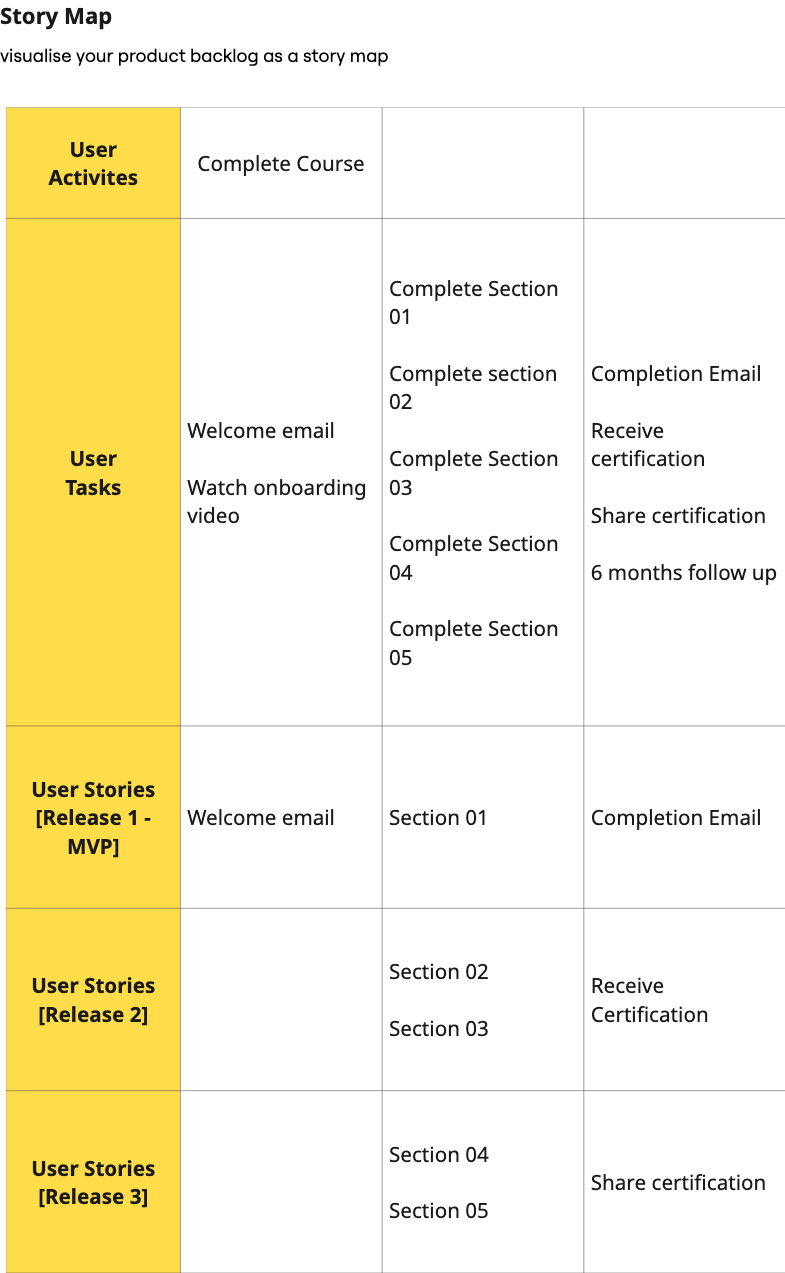
✅ Story Map: Product Loop Online Course
Step 7 – Share Your Framework
Finally, share your product discovery.
Sharing creates feedback, visibility, and momentum.
We shared our framework through:
A blog (this one 🕺🏾)
A WhatsApp community
A LinkedIn educational post
An Instagram edutainment reel
✅ Share : completed product discovery framework socialised over different communities and channels
Final Thought
The Product Discovery Framework isn’t about getting everything right the first time.
It’s about moving forward with clarity—one loop at a time.
Start simple. Stay consistent. Share your progress.
That’s how ideas turn into real products.

Become a Product Builder
Join a community of Product Builders —innovators who are turning ideas into real products.
Sign up for our mailing list today at https://mailchi.mp/itydata.com/product-loop


Useful concept!
Very good blog post. I am going to use it. Thanks for sharing 👏🏽